Deep beneath Dowding Park in Uxbridge lies one of Britain's most significant wartime secrets. The Battle of Britain Bunker, a 60-foot underground fortress of metre-thick concrete walls, served as the command centre that coordinated the nation's aerial defence during the decisive summer of 1940.
The Secret Construction of a Subterranean Stronghold
Construction of the bunker began in February 1939 and was completed in August that year, following the Munich Crisis of September 1938. Sir Robert McAlpine built the facility as a protected underground alternative to the above-ground Operations Room at RAF Uxbridge. The work was carried out in strict secrecy to prevent plans falling into enemy hands.
The bunker sits 18 metres underground, accessed by 76 concrete steps. Its walls, floor and ceiling are approximately one metre thick, designed to withstand any bomb of the period. Thirty feet of earth sit above the reinforced concrete ceiling. A ventilation and air filtration system, still operational today, was installed to ensure those working below could survive prolonged attacks.
The Nerve Centre of the Battle of Britain
The bunker housed No. 11 Group Fighter Command Operations Room throughout the Second World War. This was the group that saw the most action during the Battle of Britain, responsible for coordinating fighter aircraft across southeast England using the "Dowding System", the world's first integrated air defence network.
From this subterranean command post, Operations Controllers made split-second decisions that determined the nation's fate. They decided how many fighters to scramble, which squadrons to deploy, and where to direct them. The room coordinated seven sector stations including RAF Kenley, RAF North Weald, RAF Biggin Hill and RAF Northolt.
On 13 August 1940, known as "Eagle Day", the Luftwaffe switched its focus to British airfields. The Operations Room at Uxbridge became the critical hub tracking enemy movements and dispatching Spitfires and Hurricanes to intercept. No. 11 Group was responsible for shooting down many of the 1,733 German aircraft lost during the battle.
Churchill's Famous Words
It was here, at the entrance to this hidden Hillingdon facility, that Winston Churchill first spoke words that would become among the most famous in British history. As the Prime Minister got into his car following a visit to the bunker, he uttered the phrase: "Never in the field of human conflict was so much owed by so many to so few."
He repeated these words in the House of Commons on 20 August 1940. The Prime Minister visited the bunker on more than one occasion. His later memoirs recorded a return visit when he observed that "all of the bulbs glowed red" on the squadron state boards, indicating every No. 11 Group squadron was simultaneously engaged in combat.
King George VI and Queen Elizabeth also visited the bunker on 6 September 1940, acknowledging the critical work being done beneath the Hillingdon soil.
Inside the Operations Room
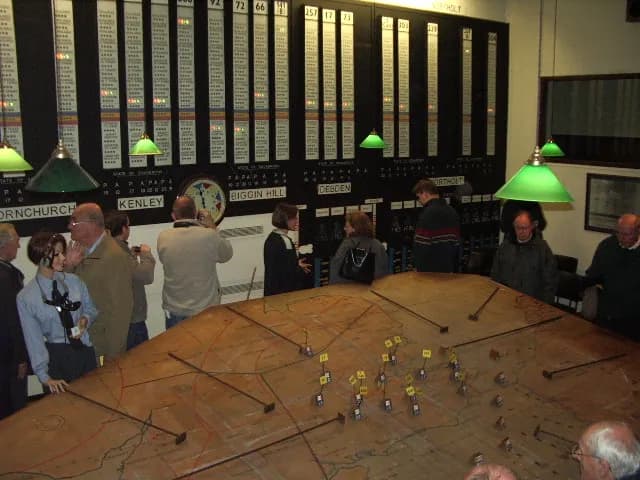
The centrepiece of the bunker is the Operations Room itself, featuring a large map table where enemy and friendly aircraft positions were tracked using numbered wooden markers. Operators used croupier-style pushing sticks to move the markers in response to information received via telephone from radar stations, the Observer Corps and sector airfields.
A "tote" board displayed squadron activities using lights to indicate states such as "At Standby", "Enemy Sighted" and "Ordered to Land". A sector clock and coloured indicators tracked the passage of time in five-minute increments. Weather conditions for each sector station were shown using coloured discs.
The room was staffed by Women's Auxiliary Air Force plotters, RAF officers and telephone operators working in shifts around the clock. The atmosphere was tense but professional; the decisions made here saved countless lives and ultimately contributed to Britain's survival.
From Secret Command Post to Heritage Attraction
After the war, the bunker remained in use until 14 April 1958, when No. 11 Group moved to RAF Martlesham Heath. In 1975, a nine-month restoration project returned the Operations Room to its wartime appearance. The facility opened for public visits in 1985, following the creation of a museum within six rooms by Warrant Officer Robert "Chris" Wren.
The bunker was designated a Grade I listed building on 1 December 2005, placing it alongside the nation's most historically significant structures. In March 2018, a new above-ground Visitor Centre opened, providing a 2,000-square-metre complex with state-of-the-art museum displays, a 95-seat auditorium, exhibition spaces covering the First and Second World Wars, and hands-on audio-visual interactives.
Visiting the Bunker Today
The Battle of Britain Bunker is located on Wren Avenue, Uxbridge, UB10 0GG, within walking distance of Uxbridge town centre and Underground station. The Visitor Centre opens seven days a week from 10:00 to 16:30, with last admission at 15:30.
Admission to the bunker tour, which includes a 45-minute talk in the Operations Room, costs £12.50 for adults and £10.00 for visitors aged over 65. Entry for under-16s is free. Visitors can also purchase tickets for the Visitor Centre exhibitions only, priced at £7.50 for adults. Hillingdon First card holders receive a 50 per cent discount.
Advance booking is recommended as tours depart promptly. Visitors should note that access to the bunker requires descending 76 steps; there is no lift due to the Grade I listed status of the structure.
The site hosts regular exhibitions including galleries dedicated to the Polish Air Force, the Dieppe Raid and VJ Day. The venue is available for private hire, accommodating groups from 20 to 200 people. A café and gift shop are located on site, with proceeds supporting the Royal Air Forces Association.
A Hillingdon Treasure
The Battle of Britain Bunker stands as perhaps the borough's most significant historical asset. From its construction beneath what is now Dowding Park to its current operation as a heritage attraction run by Hillingdon Council, the facility connects local residents directly to one of the most consequential chapters in British history.
For Hillingdon residents, the bunker offers not only a window into the past but also a tangible link to the sacrifices made in defence of the nation. The park above bears the name of Air Chief Marshal Sir Hugh Dowding, the architect of the integrated defence system that proved so effective. Below ground, the restored Operations Room preserves the atmosphere of those critical days in 1940, when the course of the war hung in the balance and decisions made in Uxbridge helped secure Britain's future.